Research on sustainable aviation receives first Research Excellence Award
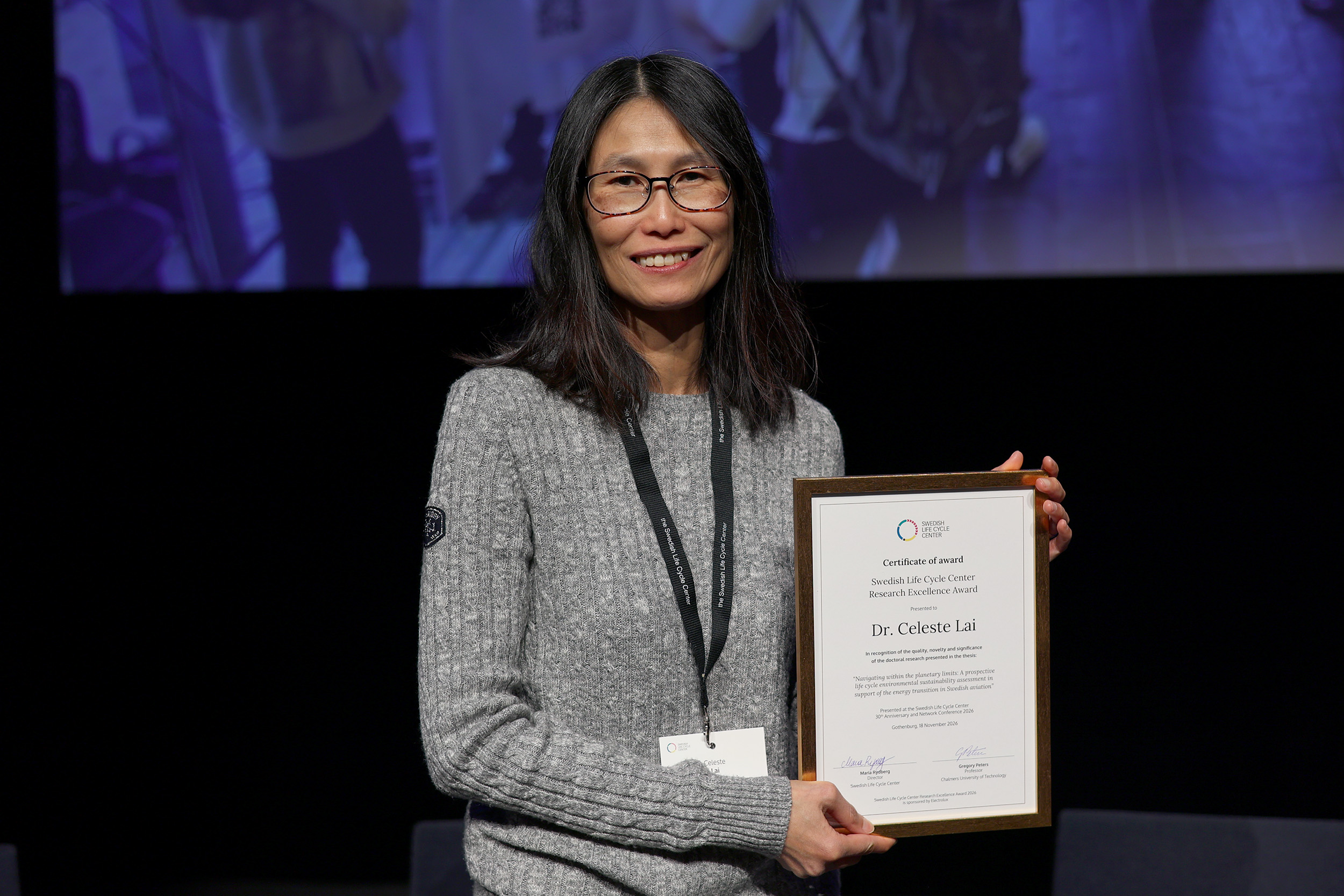
How can future air travel become more sustainable, and can it operate within planetary limits? Celeste Lai has explored these questions in her doctoral research on the energy transition in Swedish aviation. Now, her work has been recognised with the first Swedish Life Cycle Center Research Excellence Award.
The award celebrates the success and quality of life cycle research conducted by researchers who have recently completed their doctoral degree at one of the Center’s partner universities.
“It takes quite a while for the news to sink in, but I am proud to be validated and happy that the jury finds value in my research,” says Celeste Lai, who did her PhD at KTH Royal Institute of Technology and now works as an LCA researcher at RISE.
Looking at the future of Swedish air travel
Her doctoral thesis focuses on the energy transition in Swedish aviation and what it could mean for the environmental sustainability of future air travel. She explored possible scenarios for Swedish aviation, the environmental impacts associated with alternative fuels and advanced technologies, and whether future air travel could operate within planetary limits.
“My research was among the first to combine prospective LCA and absolute environmental sustainability assessment, AESA, to assess the environmental sustainability of the aviation energy system in a future context. This approach made it possible to understand how future air travel can stay within the planetary limits.”
For industry and policymakers, the findings provide insights that can help inform decisions about the future development of aviation.
“The results highlighted the significance of taking multiple environmental impacts into account when setting sustainability targets, rather than focusing solely on climate change. The work also demonstrated the need to consider the interdependencies between aviation and other sectors when designing transition pathways, as the sectors can mutually affect one another.”
Putting research into practice
Today, Celeste Lai works as an LCA researcher at RISE in Stockholm, focusing particularly on recycling technologies and circular economy solutions.
“I especially enjoy the opportunity to work with a broad range of sustainability assessment methods, including environmental LCA, life cycle costing, and social LCA.”
She hopes to see prospective LCA and AESA used more widely in industrial practice to support decisions around emerging technologies and transition pathways.
“My hope is that they will increasingly be used as practical decision support tools that create tangible value for industry stakeholders, rather than remaining primarily as tools for academia.”
About the thesis
Title: Navigating within the planetary limits: A prospective life cycle environmental sustainability assessment in support of the energy transition in Swedish aviation
University: KTH Royal Institute of Technology
About the award
The Swedish Life Cycle Center Research Excellence Award celebrates the success and quality of life cycle research conducted by researchers who have recently completed their doctoral degree at a Swedish Life Cycle Center partner university.
The jury consisted of Gregory Peters, Chalmers (Chair), Rickard Arvidsson, Chalmers, Niclas Eriksson, SLU, Siri Willskytt, AB Volvo, and Stefano Zuin, Electrolux.
The award was sponsored by Electrolux.